Politics: Congress, bills, votes and elections
On this page
Politics is the part of 4Search for following the U.S. government. You can look up a member of Congress, a bill, a vote, an election or a new federal rule, see what the official record says about it, and read the news around it, all on pages that link to one another.
Politics is available on 4Search and 4Conservative.
#A tour of the Politics page
Politics has its own search box and its own row of sections under it. The overview page, which opens when you choose the Politics tab, gathers the day's most useful records on one screen.
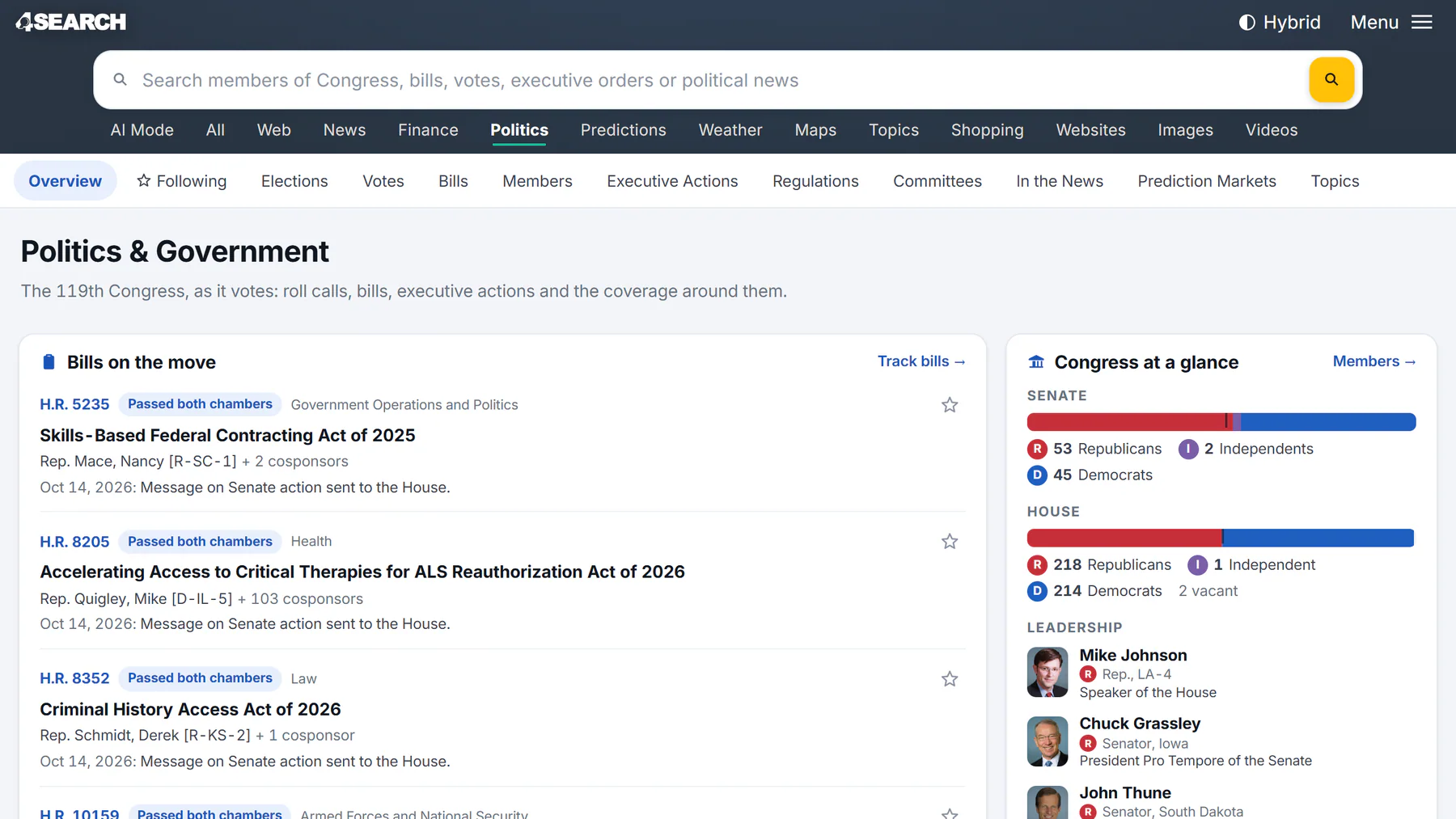
The Politics overview: the search box and sections, a card of bills on the move, and Congress at a glance. More cards follow below.
- 1The Politics search box
- 2The Politics sections
- 3Cards: bills, executive actions, votes and news
- 4Congress at a glance
The cards on the overview are:
- Latest votes in Congress: the newest House and Senate roll calls, each with its result and how each party voted. After three days without a vote, a note says when each chamber last voted, and after a week the card moves further down the page.
- Bills on the move: bills that have passed at least one chamber and have not become law yet.
- Executive actions: the President's newest executive orders, proclamations and other documents.
- Latest political news: headlines from the last few hours.
- Congress at a glance: seats by party in the Senate and the House, and the people who hold leadership posts.
- What the markets say: what prediction markets say about which party will win control of the Senate and the House, and the day's biggest moves.
- Congress in the news and Who the news is naming: the people political coverage mentioned most in the last 24 hours.
- New laws and Open for public comment: bills signed into law, and proposed federal rules that are still taking comments.
In Congress at a glance, the bar for each chamber divides its seats by party: red for Republicans, purple for independents and blue for Democrats. A thin line marks how many seats make a majority, and seats with no member are counted as vacant. The House bar does not include the delegates and the resident commissioner. Beneath the bars are the members who hold leadership posts, such as the Speaker of the House and the Senate Majority Leader.
On the overview and on member, bill, vote and race pages you will also see an AI Briefing near the top, a short summary of the page's records.
#What you can do in Politics
| Section | What you will find | Read |
|---|---|---|
| Following | One page for the members, committees, bills, races and markets you follow | Follow what matters to you |
| Elections | Control of Congress, Senate, governor and House races, with market odds and news | The Elections page |
| Votes | House and Senate roll calls, newest first | Find a roll-call vote |
| Bills | Bills and resolutions of the current Congress, by status, topic or number | Find a bill |
| Members | Every senator and representative, with their record | Browse Congress |
| Executive Actions | Executive orders, proclamations and memoranda | Executive actions |
| Regulations | New rules, and proposed rules open for comment | Federal rules and public comment |
| Committees | Who sits on each committee and subcommittee | Committees |
| In the News | Who political coverage names most | Who is in the political news |
| Prediction Markets | Odds on elections, Congress, the courts and the economy | Prediction markets |
| Topics | Political coverage by subject | Browse politics by topic |
The search box at the top finds members, bills, votes, federal documents and news. See Search Politics.
#Where the information comes from
Votes, bills, members and rules come from public government records and open government data, not from news stories. Roll-call votes come from the House Clerk and the U.S. Senate. Bill status, actions, summaries and cosponsors come from the Library of Congress through GovInfo. Executive orders, rules and proposed rules come from the Federal Register. Members and committees come from the congress-legislators project, an open public dataset of who serves in Congress and on which committees.
The records are copied on a schedule, so a page can trail the official record by a few hours, and the official source always governs. Headlines and the news counts come from the 4Search news index and show what the press published, not what 4Search thinks. Prediction-market odds come from Kalshi and Polymarket, and each market names its source. Where the information comes from explains how fresh each part is.
#What Politics does not do
- It does not take sides. It does not endorse a candidate, party or position, and it does not tell you how to vote.
- It is not an official government site. Use it to find and read the records, and follow the links to the official source when you need the authoritative text.
- It covers the current Congress, which is the 119th (2025 and 2026). Bills and votes from earlier Congresses are not here.
- It does not send alerts or emails. What you follow is shown when you open the Following page.
- It does not publish polls, and it does not show campaign donations itself. A member's page links to the Federal Election Commission for campaign finance records.
#On a phone
The sections become a row that slides sideways, and the cards stack in one column.
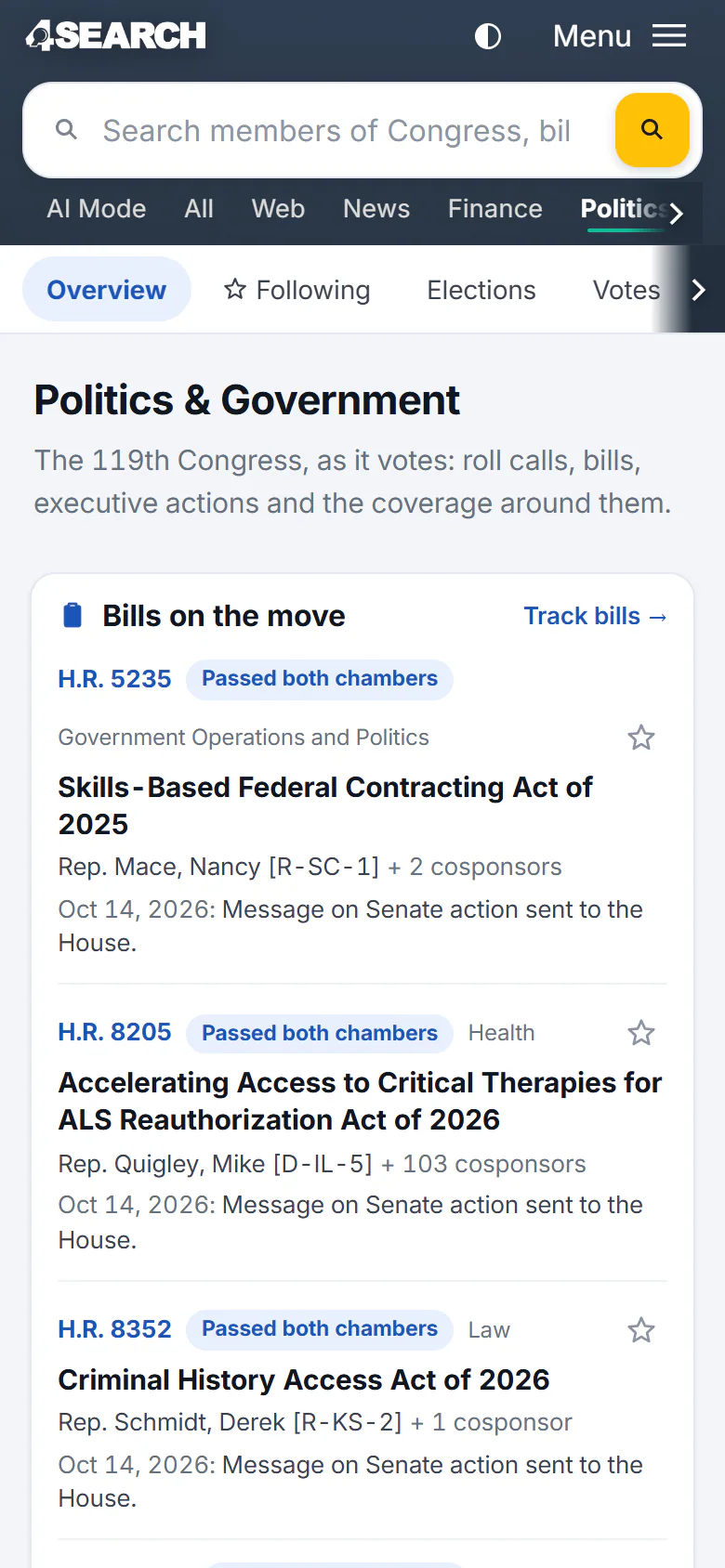
Politics on a phone. Slide the row of sections sideways to reach all of them.
- 1Search Politics
- 2The sections: slide sideways to see them all
- 3Cards stack in one column
#Common questions
What do the letters R, D and I mean?
R is Republican, D is Democrat and I is Independent. They appear as small marks beside a member's name and in vote counts, in red, blue and purple. Hover over a round mark to see the party's full name.
Is Politics an official government site?
No. It reads official public records and shows them in one place, with the news around them. Every vote page links to the House Clerk or Senate record, and every bill page links to Congress.gov. When the two differ, the official record governs.
Do I need an account to use Politics?
No. Everything in Politics works without signing in. If you choose to follow members, bills and other things, your list is kept in your browser, not in an account. See Follow what matters to you.